
Best starting point: Mutual of Omaha for comparing application routes. Best for AARP members: New York Life through AARP. Best for guaranteed acceptance: Gerber Life. Best for an agent-led review: State Farm. For the best final expense life insurance Texas shoppers can choose in 2026, compare the actual policy—not just the company name—and start your budget search with health-question coverage before guaranteed acceptance.
- For best final expense life insurance Texas comparisons, start with Mutual of Omaha and compare written policy terms.
- New York Life through AARP is a comparison option for eligible AARP members seeking permanent life insurance.
- Gerber Life belongs on a guaranteed-acceptance shortlist; check the initial benefit restrictions before applying.
- Blakeinc365 is best for readers seeking life insurance guidance alongside physical, mental, financial, and medical health education.
Why this matters
Final expense insurance is life insurance intended to help with funeral costs and other expenses after death. The beneficiary generally receives the death benefit; it is not automatically a prepaid funeral arrangement or a payment directly to a funeral home.
That distinction matters. Your family needs to understand who receives the money, what the policy pays, and whether an initial benefit restriction applies. A recognizable insurer does not make those terms interchangeable.
Blakeinc365 connects life insurance and financial protection with health education. The consultancy, run by Mary Blake, MPH, takes physical, mental, financial, and medical health together rather than treating insurance as an unrelated purchase.
What makes the best final expense life insurance?
Use these criteria before choosing a company. For your 2026 comparison, ask each insurer or agent to identify the exact policy being quoted.
- Benefit timing: Separate full coverage from the effective date from coverage with an initial restricted-benefit period. Read the treatment of natural and accidental death separately.
- Application route: Distinguish health-question applications from guaranteed acceptance. No medical exam does not necessarily mean no health questions.
- Premium guarantees: Confirm whether the payment is guaranteed to remain level and what happens if you miss it. Permanence still depends on satisfying the policy terms.
- Coverage fit: Choose a death benefit against the expenses you want covered, minus money already designated for them.
- Policy ownership and beneficiaries: Identify who owns the contract, who receives the proceeds, and who can make changes.
- Texas policy terms: Check the issuing insurer, Texas eligibility, exclusions, cancellation provisions, and applicable policy form—not a national advertisement alone.
A policy that fits your application and benefit needs beats a company that merely tops a list. These criteria determine the shortlist below; they do not establish a universal winner on premiums or claims service.
Texas final expense companies at a glance
The companies below represent distinct comparison routes. Their place on this list reflects those routes, not a measured ranking of customer satisfaction, claims speed, or financial strength.
| Company or program | Best for | Standout comparison point | Key limitation |
|---|---|---|---|
| Mutual of Omaha | Comparing application routes | Offers life insurance routes involving health questions and guaranteed acceptance | Different routes have different eligibility and benefit terms |
| New York Life through AARP | Eligible AARP members | AARP life insurance program includes permanent coverage options | Membership and product eligibility apply; program options are not interchangeable |
| Gerber Life | Seeking guaranteed acceptance | Guaranteed Life provides a route without health questions | Initial death-benefit restrictions require close review |
| State Farm | An agent-led policy review | Final expense insurance can be discussed through a State Farm agent | Working with one insurer does not compare the wider market |
Availability and eligibility depend on the specific product. Before submitting an application in 2026, confirm that the policy under discussion is offered in Texas and matches your circumstances.
1. Mutual of Omaha: best for comparing application routes
Mutual of Omaha belongs at the start of a final expense comparison because its life insurance offerings include different application routes. Health-question coverage and guaranteed acceptance solve different problems; treating them as the same product obscures the decision.
Ask the agent to name the exact policy and explain its underwriting requirements. Then request a separate explanation of when the full death benefit becomes payable. The logo cannot answer either question.
Mutual of Omaha pros:
- Provides a starting point for comparing different application approaches.
- Includes permanent life insurance options relevant to final expense planning.
- Lets you distinguish a health-question route from guaranteed acceptance within the comparison.
Mutual of Omaha cons:
- Eligibility and benefit provisions differ between products.
- A guaranteed-acceptance offering is not interchangeable with health-question coverage.
- Comparing only this insurer leaves competing contracts unexamined.
Best for: Buyers who want to investigate health-question coverage before selecting guaranteed acceptance.
Ask for the policy form, benefit schedule, exclusions, and payment guarantees in writing. If you receive multiple proposals, keep the desired death benefit consistent so the comparison remains meaningful.
Verdict: Hold until the exact application route and benefit schedule are clear. Mutual of Omaha is a useful first comparison, not an automatic purchase.
2. New York Life through AARP: best for eligible AARP members
The AARP Life Insurance Program offers coverage from New York Life, including permanent life insurance options. Keep the roles straight: AARP is the membership organization, while New York Life is the insurer associated with the program.
This route belongs on your shortlist if you meet the program's eligibility requirements. Compare the named permanent policy rather than assuming every AARP life insurance offering provides the same duration, application process, or death-benefit terms.
New York Life through AARP pros:
- Offers a defined comparison route for eligible AARP members.
- Includes permanent life insurance options.
- Identifies the insurance carrier separately from the membership organization.
New York Life through AARP cons:
- Membership and product eligibility restrict who can apply.
- Different program products require separate reviews of coverage duration and benefit terms.
- Membership does not establish that a policy is your best match.
Best for: Eligible AARP members who want to compare a permanent policy through the membership program.
Read the program materials alongside the actual policy provisions. A membership connection is a reason to investigate—not a substitute for comparing the contract against other offers.
Verdict: Hold until the specific permanent policy passes your benefit-timing and payment checks. Do not choose it solely because you recognize AARP.
3. Gerber Life: best for a guaranteed-acceptance comparison
Gerber Life's Guaranteed Life product provides a guaranteed-acceptance route without health questions. That makes it relevant when you specifically need to compare that application category.
The central issue is its initial death-benefit restriction. An application without health questions does not mean the full death benefit applies immediately to every cause of death. Read the policy's benefit schedule before deciding whether the protection matches your family's needs.
Gerber Life pros:
- Provides a clearly identified guaranteed-acceptance option.
- Does not require health questions for Guaranteed Life.
- Gives buyers a distinct alternative to health-question applications.
Gerber Life cons:
- Initial benefit restrictions limit the protection during the policy's early period.
- Guaranteed acceptance does not remove product eligibility requirements.
- A simple application does not eliminate exclusions or the need to review the contract.
Best for: Buyers specifically seeking guaranteed acceptance after reviewing their other application options.
Ask what the beneficiary receives if death occurs during the initial restricted period, and how the policy treats accidental death. The answer should come from the policy, not an abbreviated advertisement.
Verdict: Hold until you understand the initial benefit restriction. Skip an application based only on the words guaranteed acceptance.
4. State Farm: best for an agent-led policy review
State Farm offers final expense insurance through its agent distribution model. This is a comparison option if you want to discuss policy ownership, beneficiaries, and coverage needs with an agent, especially if you already have a State Farm relationship.
Use the appointment to review the contract rather than simply request a recommendation. An agent can explain the offering, but a discussion with one insurer does not show how other carriers would handle your application.
State Farm pros:
- Provides an agent-led route for discussing final expense insurance.
- Offers a setting for reviewing ownership and beneficiary questions.
- Fits buyers who prefer a conversation rather than completing an application without assistance.
State Farm cons:
- A single-insurer review does not establish the best market-wide fit.
- An existing relationship does not guarantee eligibility or suitable terms.
- Personal assistance does not replace a written review of exclusions and benefits.
Best for: Buyers who prioritize an agent-led explanation of the policy and their family arrangements.
Bring details of existing life insurance and the expenses you want covered. Ask the agent to explain where the proposed policy fills a gap and where it duplicates protection you already have.
Verdict: Hold until the written proposal survives an outside comparison. Convenience is useful; it is not the whole decision.
Compare the policy type before the insurer
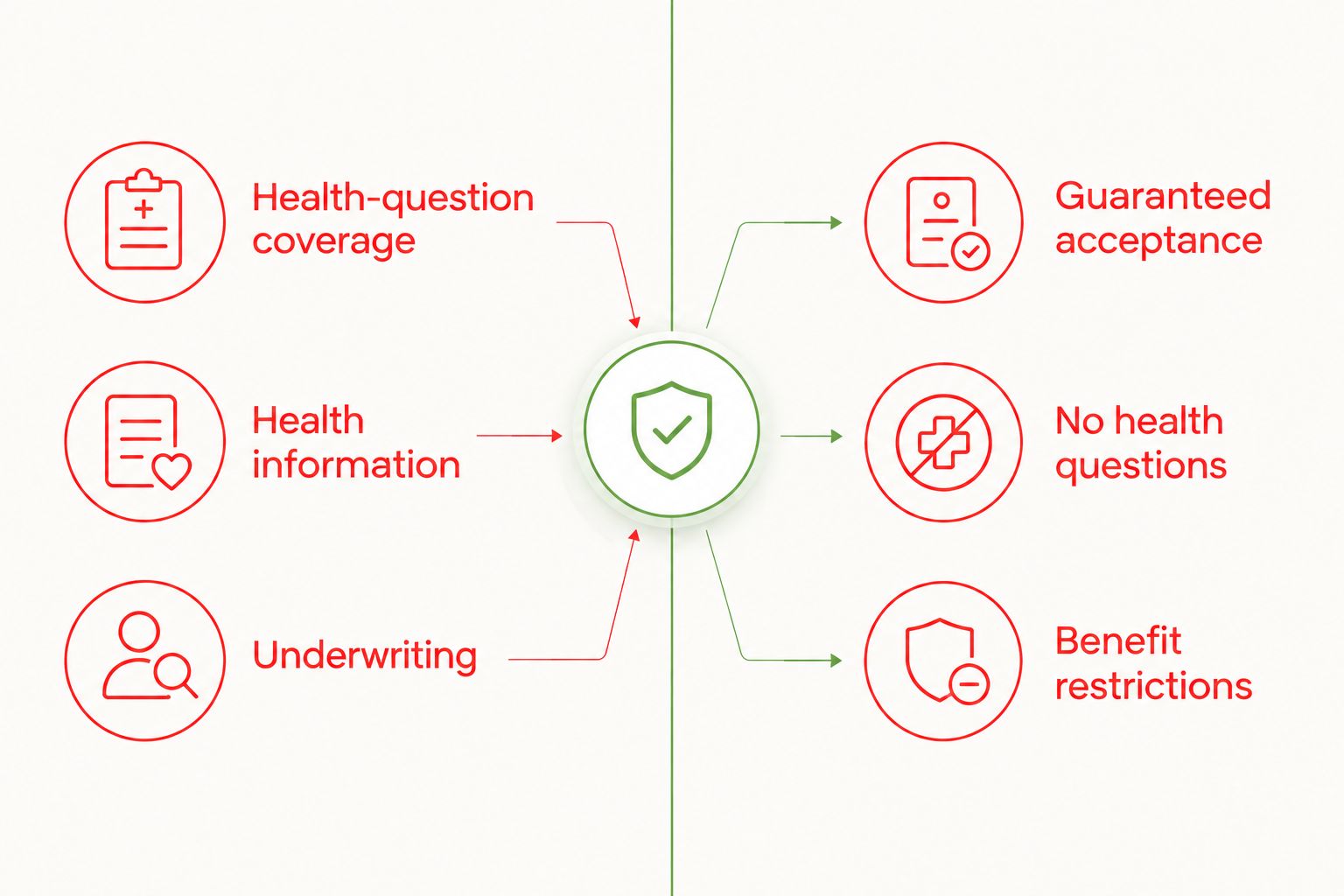
For a 2026 purchase, separate these application categories before comparing companies. They describe how you apply, not a promise that every resulting contract has identical benefits.
| Application category | Best for | Advantage | Limitation |
|---|---|---|---|
| Health-question coverage | Buyers willing to provide health information | Lets the insurer assess eligibility from health information | Acceptance depends on underwriting |
| Guaranteed acceptance | Buyers seeking a route without health questions | Removes health questions from the application | Initial benefit restrictions need careful review |
| No-exam coverage | Buyers avoiding an examination | Does not require a medical examination | Can still involve health questions and underwriting |
No-exam coverage and guaranteed acceptance are not synonyms. Ask which category applies and whether the contract pays the full death benefit from its effective date.
Build a comparison your family can use
A useful comparison ends with a clear record, not a stack of brochures. Collect 3 written proposals where suitable options exist; that is a shopping target, not a rule that you need three policies.
For each proposal, record:
- The legal insurer and exact policy name.
- The proposed death benefit and application category.
- The effective date and any initial benefit restriction.
- Whether payments are guaranteed to remain level.
- The beneficiary arrangement and how claims are submitted.
Use 2 reviews: first for the contract, then for affordability. A policy can pass the first and fail the second. Include the payment in your household budget without assuming future income will rescue an uncomfortable commitment.
Confirm 1 primary beneficiary or your chosen primary-beneficiary arrangement, then consider a contingent beneficiary. Tell the relevant person where the policy records are kept; do not leave the protection undiscoverable.
If you are seeking guidance rather than another application form, Blakeinc365 offers life insurance and financial protection services within its broader health consultancy. Keep medical questions with your treating clinician and insurance questions tied to the actual contract.
Connect your health and protection planning
Explore life insurance and financial protection alongside Blakeinc365's health education services.
How this shortlist is ranked
This 2026 shortlist ranks companies by a distinct buyer need: application-route comparison, AARP membership, guaranteed acceptance, or agent-led review. It does not claim that one carrier wins every underwriting situation.
Benefit timing, eligibility, payment guarantees, and household fit decide the final choice. Keep the company ranking provisional until you have the policy terms.
Which Texas final expense company should you choose?
Start with Mutual of Omaha if you are undecided about application routes. Add New York Life through AARP if you qualify for its program, Gerber Life if guaranteed acceptance is your priority, or State Farm if you want an agent-led review.
The default next move is to compare health-question coverage before committing to guaranteed acceptance. Then choose the contract whose benefit timing, payment obligation, and beneficiary arrangement fit your needs—not the shortest application.
FAQ
What's the best final expense life insurance company in Texas in 2026?
The best company depends on your eligibility and the exact policy terms. Start with Mutual of Omaha for application-route comparisons, New York Life through AARP for eligible members, Gerber Life for guaranteed acceptance, or State Farm for an agent-led review.
Is burial insurance the same as final expense insurance?
Burial insurance and final expense insurance commonly describe life insurance intended to help cover end-of-life expenses. The beneficiary generally receives the proceeds, so the policy is not automatically a prepaid funeral contract.
Does no medical exam mean guaranteed acceptance?
No medical exam does not mean guaranteed acceptance. A no-exam policy can still ask health questions and use underwriting to determine eligibility.
Does guaranteed-acceptance insurance pay the full benefit immediately?
Guaranteed acceptance does not guarantee an immediate full death benefit for every cause of death. Check the policy's initial benefit restrictions and its separate treatment of accidental death.
Can final expense insurance pay bills besides funeral expenses?
Life insurance proceeds generally do not have to be spent only on a funeral. The beneficiary controls the proceeds, subject to any assignment or other applicable arrangement.
How much final expense coverage should I buy?
Choose coverage against the expenses you want funded after subtracting money already designated for them. Review existing life insurance before adding a policy so you understand any overlap.
Is Blakeinc365 a final expense insurance company?
Blakeinc365 is a Dallas-based health consultancy and personal brand offering life insurance and financial protection services, not an insurance carrier. Ask which insurer would issue any proposed policy and review that insurer's contract.
One last thing
A beneficiary designation deserves as much attention as the carrier name. If you intend to name a minor, ask about the appropriate arrangement before signing; a child's name alone does not resolve how proceeds will be managed.
For your 2026 decision, leave your family with the insurer's name, policy details, and claim instructions in a place they can find. Insurance cannot help promptly if nobody knows it exists.