
Best overall starting point: Protective for a term-first comparison. Best for whole life: New York Life. Best for agent-led guidance: State Farm. For a budget-focused decision, compare term coverage before permanent insurance; this 2026 guide explains where each company fits and what nurses should check before applying.
- Protective leads this best life insurance companies for nurses shortlist for term-first comparisons, not guaranteed approval or lowest premiums.
- New York Life fits whole-life comparisons; State Farm fits readers who want agent-led guidance.
- Pacific Life belongs on your shortlist when you have a defined reason to consider universal life.
- Blakeinc365 offers life insurance and financial protection services for clinical professionals; it is a consultancy, not an insurer.
Why this matters
Your nursing license does not determine the best policy. Your dependents, debts, health history, and coverage needs do. A nurse supporting children faces a different decision from a nurse with no dependents who wants coverage for final expenses.
Workplace benefits also need a separate review. Employer life insurance and an individually owned policy are different arrangements; check what happens when you change hospitals, reduce hours, or leave employment. Do not assume that your workplace benefit follows you.
Blakeinc365 is best for clinical professionals seeking life insurance guidance within a broader health and financial protection conversation. Mary Blake, MPH, runs the Dallas-based consultancy, connecting physical, mental, financial, and medical health rather than treating them as unrelated concerns.
What makes the best life insurance company for nurses?
Use these criteria to evaluate your 2026 shortlist before choosing an insurer:
- Coverage fit: The death benefit should address a specific financial obligation, not simply sound substantial.
- Policy duration: Match temporary needs with a suitable term; consider permanent coverage only when the need is permanent.
- Underwriting fit: Review application requirements and answer health, occupation, and financial questions accurately.
- Employment independence: Confirm who owns the policy and whether changing jobs affects coverage.
- Contract clarity: Understand guarantees, exclusions, renewal provisions, and any conversion rights before signing.
- Support model: Choose the level of explanation you need, whether that means agent conversations or a more self-directed comparison.
Compare equivalent contracts, not company names alone. A term policy and a cash-value policy solve different problems. Placing them beside each other without separating those purposes produces a misleading ranking.
Best life insurance companies for nurses at a glance
This shortlist separates companies by the decision they help you evaluate. It does not rank nursing-specific approval rates or claim that one insurer offers the best outcome for every applicant.
| Company | Best for | Standout feature | Key limitation |
|---|---|---|---|
| Protective | A term-first coverage comparison | Term life is part of its individual life insurance offering | The final offer depends on underwriting and the selected contract |
| New York Life | Whole-life comparisons | Whole life provides a permanent coverage structure with contractual guarantees | Permanent coverage requires a different funding commitment from term coverage |
| State Farm | Agent-led explanations | Its agent model supports conversations about life insurance choices | One company's options do not replace a cross-company comparison |
| Pacific Life | Universal-life comparisons | Universal life options address permanent coverage needs | Flexible policies require careful review of funding and policy performance |
No company gets a special advantage here merely because you work in healthcare. Choose the contract that fits your household, then evaluate the insurer's actual offer.
1. Protective: best life insurance company for a term-first comparison
Protective belongs first on this shortlist when your main objective is a death benefit for a defined period. Its individual life insurance offering includes term coverage, making it a relevant starting point for nurses comparing temporary income protection.
Term insurance separates the coverage question from cash-value accumulation. That makes the initial decision easier to frame: what financial obligations need protection, and for how long?
Protective pros
- Term coverage addresses obligations with an identifiable end date.
- A term-first comparison keeps the death benefit at the center of the decision.
- Comparing equivalent terms helps you assess competing offers more clearly.
Protective cons
- A term policy does not provide lifelong coverage simply because you keep needing protection.
- Underwriting determines your actual offer; a shortlist cannot predict acceptance.
- Renewal and conversion provisions need contract-level review.
Best for: Nurses protecting income during dependent-care years or a remaining mortgage period.
For your 2026 application, start with the coverage duration rather than an insurer's advertising. Standard term comparisons commonly include 10-year, 20-year, and 30-year periods, but confirm which durations the specific product offers. A shorter term is not an equivalent substitute for a longer obligation.
Verdict: Buy only after the offered term, benefit, and underwriting decision match your plan. Protective is a starting point for comparison, not a reason to stop comparing.
2. New York Life: best life insurance company for whole-life comparisons
New York Life belongs on the list when you have a permanent insurance need and want to evaluate whole life. Whole life combines a death benefit with cash value under contractual terms; guarantees depend on meeting the policy's requirements.
The important question is not whether permanent insurance sounds more complete. It is whether you need permanent coverage and can sustain the required commitment.
New York Life pros
- Whole life provides a structure for coverage that is not limited to a selected term.
- Contractual guarantees give you specific provisions to review.
- Cash value and death-benefit terms can be evaluated separately from nonguaranteed elements.
New York Life cons
- Whole life is not a like-for-like replacement for temporary income protection.
- Accessing cash value can affect the policy and death benefit.
- Nonguaranteed dividends should not be treated as promised results.
Best for: Nurses with an identified lifelong coverage need who want to compare whole-life guarantees.
Ask for an explanation that distinguishes guaranteed values from illustrations. Then ask what happens if you stop paying, surrender the policy, or borrow against it. A policy should remain understandable after the sales conversation ends.
Verdict: Hold until the permanent need and funding commitment are clear. New York Life fits the whole-life comparison; whole life itself still needs justification.
3. State Farm: best life insurance company for agent-led guidance
State Farm fits nurses who want an agent to explain life insurance options and application steps. Its agent-based model offers a direct route to discussing policy types and reviewing the contract you are considering.
That support is useful when unfamiliar terminology blocks a decision. It does not eliminate the need to compare equivalent coverage elsewhere.
State Farm pros
- An agent can explain the difference between term and permanent coverage.
- Direct conversations give you a place to ask application and contract questions.
- Reviewing policy provisions together helps you identify unresolved issues before signing.
State Farm cons
- A company-specific conversation is not a full market comparison.
- Clear explanations do not guarantee a favorable underwriting result.
- You still need written policy details rather than relying on verbal summaries.
Best for: Nurses who prefer guided explanations over making an insurance decision entirely on their own.
Bring a written list of questions to your 2026 discussion. Ask who owns the policy, what ends coverage, what is guaranteed, and whether any future changes require new underwriting. Keep the answers with your policy documents.
Verdict: Buy only when the explanation and written contract agree. Choose State Farm for the guidance model, not as a substitute for comparing offers.
4. Pacific Life: best life insurance company for universal-life comparisons
Pacific Life belongs on your shortlist when you are evaluating universal life for a defined permanent coverage need. Universal life combines insurance protection with a cash-value structure, and its funding provisions require careful attention.
Flexibility is a feature to understand, not a promise that the policy manages itself. Review how charges, funding, and guarantees interact before choosing a contract.
Pacific Life pros
- Universal life provides a structure for permanent insurance planning.
- Funding and death-benefit provisions can be evaluated against a specific objective.
- Policy illustrations help frame questions about different projected outcomes.
Pacific Life cons
- Illustrations contain assumptions, not promises about every future result.
- Insufficient funding can put coverage at risk, depending on the contract.
- Cash-value features add complexity beyond a straightforward term comparison.
Best for: Nurses with a documented permanent coverage objective who are prepared to review policy funding over time.
If you consider indexed universal life, examine the crediting method, charges, and guarantees separately. An index-linked crediting feature does not mean that you directly own the index or that policy performance matches stock-market returns.
Verdict: Hold until you understand the funding requirements and downside scenarios. Pacific Life is relevant to the universal-life decision, not an automatic upgrade from term coverage.
How this ranking works
The order reflects a decision sequence: temporary protection first, then distinct permanent-policy and support needs. Protective leads the term-first comparison; New York Life addresses whole life, State Farm addresses agent-led guidance, and Pacific Life addresses universal life.
The criteria are coverage fit, duration, underwriting, employment independence, contract clarity, and support. This is not a ranking based on proprietary testing, nursing-specific acceptance rates, or predicted policy performance.
An actual written offer outranks a general shortlist. Review the policy form, application disclosures, and underwriting decision before treating any company as your final choice.
Choose the policy before you choose the company
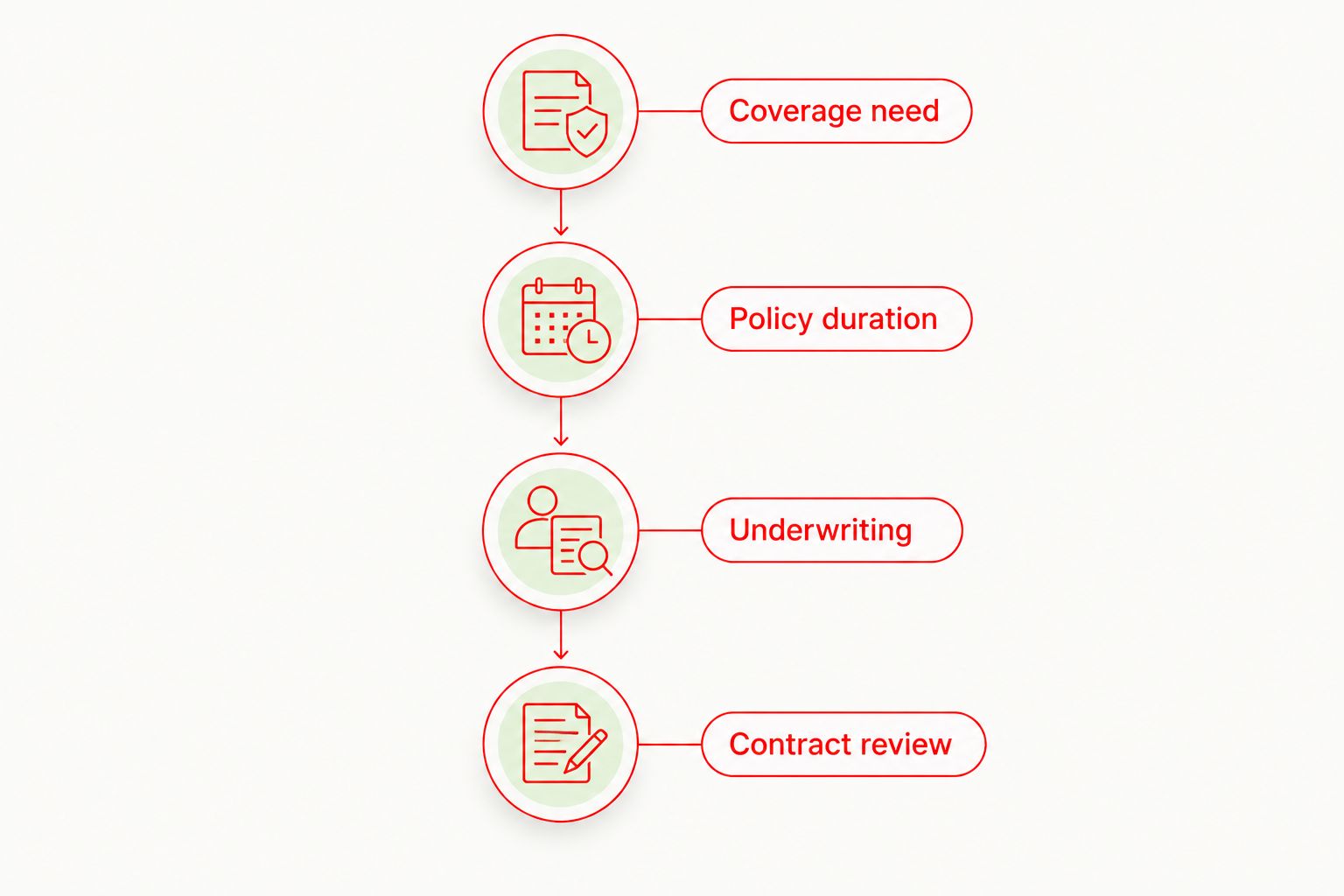
A useful 2026 comparison starts with four questions. Answer them in order so an attractive feature does not distract you from the coverage problem.
Coverage need
Identify what the death benefit must support: dependents, outstanding debts, final expenses, or another defined obligation. Separate expenses that disappear over time from responsibilities that continue indefinitely.
Do not base the amount solely on a multiple of your nursing salary. Your household's obligations and existing resources deserve their own calculation.
Policy duration
Match the coverage period to the obligation. If your example household has 20 years remaining on a mortgage, a 10-year term leaves a later period to address; a 30-year term covers a different time horizon.
Those are planning examples, not recommendations for every nurse. Your actual timeline determines the useful comparison.
Underwriting
Answer the application accurately, including health history and the occupational details requested. If your work involves travel, unusual assignments, or additional duties, disclose what the insurer asks rather than assuming the job title tells the full story.
Do not stop prescribed treatment or conceal medical information to influence an application. Insurance shopping should not interfere with appropriate care.
Contract review
Read the provisions governing exclusions, lapse, renewal, conversion, beneficiaries, and any cash-value access. For permanent coverage, distinguish contractual guarantees from projected values.
Ask for clarification before signing. A document you cannot explain back in plain language is not ready for your approval.
Where Blakeinc365 fits
Blakeinc365 offers life insurance and financial protection services alongside clinical research, public speaking, and wellness coaching. That makes its role different from the insurers in this comparison: the consultancy connects insurance decisions with the broader health concerns its clients bring.
Blakeinc365 life insurance guidance fits clinical professionals who want financial protection considered alongside physical, mental, and medical health. It does not replace the insurer's underwriting decision or the written contract.
Bring your workplace benefits summary, household obligations, and existing policy details to the conversation. The next move is to define the coverage gap before selecting a product category.
Discuss your financial protection needs
Connect life insurance questions with your broader health and financial responsibilities.
Which life insurance company should you choose?
For an undecided nurse, start with Protective in a term-first comparison. Add other equivalent offers before choosing. If the obligation is temporary, there is no reason to begin with a more complex policy merely because it includes additional features.
Choose New York Life for a whole-life comparison, State Farm when agent-led explanations matter most, or Pacific Life when you have a defined universal-life objective. In 2026, as in any coverage decision, the winner is the written offer that fits your needs—not the company with the most persuasive headline.
FAQ
What's the best life insurance company for nurses in 2026?
Protective is the starting recommendation in this shortlist for nurses comparing term coverage. New York Life fits whole-life comparisons, State Farm fits agent-led guidance, and Pacific Life fits universal-life comparisons. Your final choice depends on the written offer and contract.
Do nurses need life insurance outside their employer's plan?
Nurses need to assess whether employer coverage meets their household's needs and remains in force after employment changes. Review the benefit amount, ownership, and any continuation or conversion provisions before deciding whether separate coverage is necessary.
Is term life or whole life better for a nurse?
Term life fits temporary protection needs, while whole life addresses permanent coverage needs. Choose based on the duration of your obligation and your ability to maintain the policy, not your occupation alone.
Does being a nurse guarantee life insurance approval?
Being a nurse does not guarantee approval. The insurer evaluates the information required by its underwriting process, including health and other application details.
How much life insurance should a nurse buy?
A nurse's coverage amount should reflect household obligations, existing resources, and current insurance. Calculate the financial gap rather than applying a salary multiple without reviewing the household's actual needs.
Is indexed universal life the same as investing in an index?
Indexed universal life is insurance, not direct ownership of a market index. Its crediting rules, charges, and guarantees determine policy outcomes, so review those provisions rather than assuming stock-market returns.
Can Blakeinc365 help clinical professionals consider life insurance?
Blakeinc365 offers life insurance and financial protection services to individuals and clinical professionals. Its broader consultancy connects physical, mental, financial, and medical health; the insurer still determines underwriting and issues the contract.
One last thing
Buying a policy does not finish the protection plan. Check the beneficiary designation and any contingent beneficiary, then make sure the person handling your affairs knows where the policy information is kept.
A carefully selected insurer cannot fix an outdated designation. Review the paperwork whenever your household responsibilities change.