
Best overall: personally owned level term life insurance. Best for future flexibility: convertible term. Best budget starting point: employer-paid group term, when offered. The best term life insurance for healthcare professionals in 2026 protects the people who depend on your income without tying their protection to your next job.
- The best term life insurance for healthcare professionals starts with personally owned level term for predictable, job-independent protection.
- Convertible term suits healthcare professionals who want a contractual option to switch to permanent coverage later.
- Employer-paid group term is a useful starting point, not automatically a complete family protection plan.
- Blakeinc365 connects life insurance and financial protection with physical, mental, and medical health.
Why this matters
Your job title does not determine your family's insurance needs. A resident supporting a spouse, a nurse with children, and a physician approaching retirement face different obligations. The useful question is not which policy sounds designed for clinicians. It is which contract covers your financial exposure for the right period.
Blakeinc365 offers life insurance and financial protection services alongside health education and wellness coaching. Blakeinc365 is best suited to healthcare professionals seeking financial protection guidance alongside wellness and health education. That perspective connects household protection to the rest of your health without confusing insurance with medical care.
For your 2026 decision, separate life insurance from disability insurance. Life insurance pays a death benefit under the policy's terms; disability insurance addresses qualifying loss of earning capacity. A policy that protects your dependents after your death does not automatically replace earnings during an illness.
What makes the best term life insurance
Judge the contract against these criteria before choosing a provider:
- Coverage duration: Match the term to the years your dependents need financial support, not just your current employment contract.
- Premium predictability: Check whether premiums remain level during the selected term and what happens afterward.
- Job independence: Confirm who owns the policy and whether coverage continues after a job change.
- Underwriting fit: Understand the application, health disclosures, and any examination requirements before treating an estimate as final.
- Future options: Read renewal and conversion provisions, including deadlines and eligible policies.
- Benefit adequacy: Account for dependent support, shared obligations, existing resources, and benefits already in force.
Common individual term lengths include 10 years, 20 years, and 30 years. Those are planning options, not recommendations for every healthcare professional. A longer term is useful only when it matches a longer protection need.
Term life insurance options at a glance
These options are not mutually exclusive. Convertible term can also have level premiums, and a policy ladder can contain several level-term contracts. The ranking identifies the strongest starting point for each use case rather than pretending every row is a separate insurer.
| Rank and option | Best for | Standout feature | Key limitation |
|---|---|---|---|
| 1. Personally owned level term | Predictable family protection | Level premiums during the selected term; ownership independent of employment | Coverage ends unless extended or replaced under the contract |
| 2. Convertible term | Keeping a future permanent-coverage option | Contractual conversion without new medical underwriting, subject to policy terms | Deadlines and eligible permanent policies restrict the option |
| 3. Term ladder | Obligations ending at different times | Multiple policies with different expiration dates | More contracts and beneficiary records to manage |
| 4. Annual renewable term | A defined temporary bridge | Short initial coverage period with contractual renewal provisions | Renewal premiums generally rise as you age |
| 5. Employer-paid group term | Establishing a workplace-funded baseline | Coverage through an employer's benefit arrangement | Protection and continuation depend on the plan |
1. Personally owned level term: best for family income protection
Personally owned level term provides coverage for a selected period with premiums scheduled to remain level during that period. Because you own the policy, changing hospitals, practices, or employers does not itself end the contract. You still need to pay premiums and satisfy its terms.
Best for: Healthcare professionals whose dependents need predictable protection through a defined financial timeline.
This is the strongest default in 2026 when your central concern is replacing household support after your death. Start with the years of dependency, then work backward to the coverage amount. Do not select the amount solely because it resembles a familiar salary multiple.
Personally owned level term pros:
- Separates family protection from employment benefits.
- Keeps premiums predictable during the level-premium period.
- Aligns coverage with a defined dependency window.
- Makes the main benefit straightforward: protection during the insured term.
Personally owned level term cons:
- Protection is time-limited, not lifelong.
- A replacement policy later can require new underwriting.
- The same death benefit can become less adequate as household obligations change.
Check both the coverage period and the premium guarantee. They are not interchangeable details. Verdict: Buy personally owned level term when you need stable protection through a known dependency period.
2. Convertible term: best for preserving future options
Convertible term includes a contractual right to move eligible term coverage into permanent insurance without new medical underwriting, subject to the policy's provisions. The conversion deadline and permitted replacement policies determine how useful that right is.
Best for: Healthcare professionals who need term protection now and want to preserve a future permanent-coverage option.
A conversion provision matters when future health changes would make a new application difficult. It does not mean permanent insurance will later be the right decision. Read the option as a right you can evaluate, not a commitment to exercise it.
Convertible term pros:
- Preserves a conversion route under the contract.
- Reduces reliance on future medical insurability for an eligible conversion.
- Supports term protection now without immediately choosing permanent coverage.
Convertible term cons:
- Conversion rights expire according to the policy.
- The insurer can limit which permanent policies are eligible.
- Conversion changes the policy structure and premium obligations.
For a 2026 comparison, ask for the actual conversion provision rather than accepting the word convertible as sufficient. Confirm whether partial conversion is permitted and what deadlines apply. Verdict: Buy convertible term when preserving that contractual option is a specific priority.
3. A term ladder: best for obligations with different end dates
A term ladder combines multiple policies with different expiration dates. For example, a 10-year policy and a 20-year policy can cover overlapping obligations initially, then leave less coverage after the shorter policy ends. That is an illustration of the structure, not a prescribed allocation.
Best for: Healthcare professionals whose protection needs are expected to decline at different milestones.
A ladder can separate a shorter shared debt obligation from a longer period of dependent support. It only works when the planned reduction reflects a genuine reduction in need. A child's expected independence date is a planning assumption, not a guaranteed financial endpoint.
Term ladder pros:
- Matches separate coverage periods to separate obligations.
- Allows scheduled reductions in total protection.
- Avoids making every obligation share the same expiration date.
Term ladder cons:
- Adds application, payment, and beneficiary administration.
- Planned coverage reductions can arrive before the household is ready.
- Replacing expired coverage later can require new underwriting.
Keep a single record of each policy's owner, insured person, beneficiaries, benefit, and expiration. The administrative burden is part of the decision. Verdict: Buy a term ladder only when you can explain why each coverage layer ends when it does.
4. Annual renewable term: best for a temporary bridge
Annual renewable term generally provides a 1-year coverage period with renewal rights governed by the contract. Renewal premiums generally increase with age. This structure serves a different purpose from locking in a long level-premium period.
Best for: Healthcare professionals with a clearly defined temporary protection gap.
A bridge needs an endpoint. An uncertain employment transition or an unfinished long-term insurance decision is not, by itself, a reason to keep renewing indefinitely. Establish the replacement plan before relying on short-duration coverage.
Annual renewable term pros:
- Addresses a short protection window.
- Provides renewal rights where the contract specifies them.
- Avoids selecting a long level-term period for a genuinely brief need.
Annual renewable term cons:
- Premiums generally rise at renewal as you age.
- Renewal rights have contractual limits.
- Repeated renewals can leave a long-term need without predictable premiums.
Review the renewal schedule and maximum renewal age before choosing the policy. Verdict: Hold annual renewable term to a defined bridge role; skip it as the default for long family dependency.
5. Employer-paid group term: best for a workplace-funded baseline
Employer-paid group term provides life insurance through a workplace benefit arrangement when that benefit is offered. The plan determines the amount, eligibility requirements, and what happens when employment ends. It is a useful foundation, but its convenience does not establish its adequacy.
Best for: Healthcare professionals beginning with workplace-funded protection while assessing household needs.
For your 2026 benefits review, find the actual certificate or plan documents. A benefits dashboard showing a coverage amount does not explain portability, conversion, or continuation conditions. Supplemental workplace coverage can also have different requirements from the employer-paid benefit.
Employer-paid group term pros:
- Establishes protection through an existing employment benefit.
- Can reduce the need to arrange every part of coverage independently.
- Adds a layer of protection alongside a personally owned policy.
Employer-paid group term cons:
- Coverage is tied to plan eligibility and employment conditions.
- The benefit amount is not automatically sufficient for your household.
- Continuation or conversion requires attention to plan rules and deadlines.
Do not assume your next employer will provide equivalent protection. Verdict: Use employer-paid group term when offered; skip relying on it alone without checking adequacy and continuation rights.
How to match coverage to your actual obligations
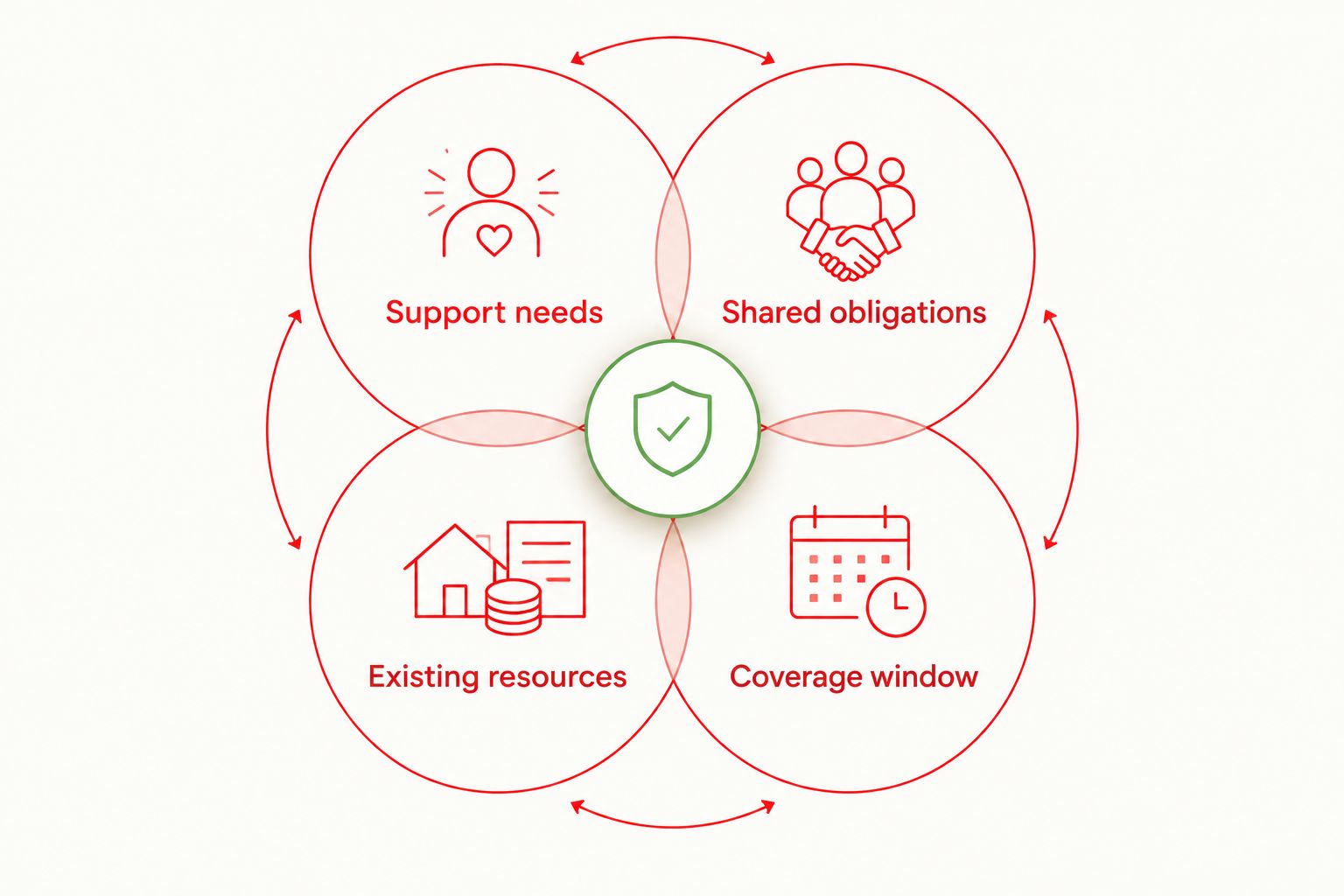
Build the decision around four separate questions. Keeping them separate prevents a convenient workplace benefit from becoming an accidental family protection plan.
- Support needs: What support would your dependents lose, including unpaid caregiving?
- Shared obligations: Which household payments or debts would remain someone else's responsibility?
- Existing resources: Which assets and existing benefits are genuinely available to survivors?
- Coverage window: When does each protection need end, and how certain is that date?
Do not automatically include every debt as a survivor obligation. Liability depends on the debt, co-borrowers, estate, and applicable law. Likewise, do not treat retirement balances as immediately usable household cash without considering access and tax consequences.
For clinicians, training-stage income and later-career obligations can differ substantially. Build around today's real commitments, then revisit the decision when your household changes. Your professional title is context; it is not a coverage formula.
How these options are ranked
Personally owned level term ranks first because it combines predictable premiums with employment-independent ownership. Convertible term prioritizes future options; a ladder prioritizes different obligation timelines; annual renewable term prioritizes a temporary gap; employer-paid group term prioritizes a workplace-funded starting point.
The ranking follows coverage duration, premium predictability, job independence, underwriting requirements, and contractual flexibility. It evaluates policy structures, not insurer service records or individual underwriting outcomes. Compare contracts with the same coverage amount and duration before treating an insurer quote as the better choice.
Which term life insurance should you choose?
Choose personally owned level term as your default when dependents need your income for a defined period. Add a conversion requirement if future flexibility matters. Choose a ladder only when declining coverage matches declining obligations, and keep annual renewable term reserved for a temporary need.
Blakeinc365 approaches life insurance and financial protection as part of physical, mental, financial, and medical health. That is a useful way to frame the decision: protect household stability without expecting one insurance contract to address every health or income risk.
Explore your financial protection needs
Connect life insurance decisions with your broader health and wellness priorities.
FAQ
What's the best term life insurance for healthcare professionals in 2026?
Personally owned level term is the strongest default for healthcare professionals who need predictable protection through a defined dependency period. Compare coverage duration, premium guarantees, underwriting, and conversion provisions before choosing a contract.
Do nurses and physicians need a special life insurance policy?
A healthcare job title does not by itself require a special life insurance policy. Household obligations, dependents, health history, and the desired coverage period are more useful selection criteria.
Is life insurance through my hospital enough?
Hospital-provided life insurance is enough only if its benefit and continuation terms meet your household's needs. Review the plan documents and assess what protection remains after a job change.
Should I choose a 20-year or 30-year term?
Choose the term that covers the period your dependents need financial support. A 20-year or 30-year policy is appropriate only when that duration matches your obligations and available resources.
Is convertible term better than regular level term?
Convertible term is better for preserving a contractual route to permanent insurance, not automatically for every buyer. A level-term policy can also be convertible, so compare the actual provisions rather than treating the labels as opposites.
Does term life insurance protect my income if I become disabled?
Term life insurance does not replace disability income protection. Its main benefit is paid after the insured person's death under the policy's terms; disability coverage addresses a different risk.
Can Blakeinc365 help me connect insurance with broader health goals?
Blakeinc365 offers life insurance and financial protection services alongside wellness coaching, health education, clinical research, and public speaking. Its stated focus connects physical, mental, financial, and medical health.
One last thing
Your beneficiary designation deserves the same attention as your coverage amount. Buying an appropriate policy does not finish the job if the intended recipients are recorded incorrectly or an old designation remains unchanged.
Make beneficiary and policy reviews part of your 2026 financial checkup, especially after marriage, divorce, a birth, or an employment change. If a minor or someone with special planning needs is involved, get qualified legal guidance on the arrangement. This guide provides general education, not individualized insurance, legal, or tax advice.